Sunday, October 20, 2013

Dubai, the land of heritage sites

Dubai, the second largest of the seven Emirates constituting the United Arab Emirates and the most vibrant and economically active city in the Middle East region, ever wishes  its citizens and residents to remember and cherish the cultural heritage.

The Government - in particular, its visionary rulers - has always prioritized heritage to dominate during the planning phases of the city's infrastructure development projects.


During construction of the Metro rail project in Dubai, heritage played a key role.  Several Metro stations depict the significance played by heritage of the Emirates.  See some of the visuals below.


Saturday, April 09, 2011

The relevance of "Satyagraha" in the 21st century!

Kisan Baburao Hazare alias Anna Hazare, has demonstrated to the whole world once again the relevance of the Gandhian model of peaceful, powerful and mass struggle popularly known as "Satyagraha" even in modern India of the 21st century!

The septuagenerian ex-serviceman was born in a small village in western Maharashtra called Bhinagar, near Ralegan Siddhi in Ahmednagar district, in an agrarian family, on 15th June 1938, less than 10 years before the assassination of Mahatma Gandhi who eventually inspired Anna Hazare to adopt the path of non-violence in his struggles against the powerful Government.  Anna joined the Indian Army when he was vicenarian, responding to  the Army's call following the Indo-Chinese border conflict, and opted for voluntary retirement after he had a close encounter with death during the Indo-Pakistan war that led to his firm determination to remain a chronic bachelor and he returned to his village.  Swami Vivekananda and Mahatma Gandhi greatly influenced Anna in his endeavours and struggles against alcoholism, social inequality, untouchability and corruption. His campaign for Right to Information Act from1997 resulted in the State of Maharasthra enacting the legislation, eventually adopted by the Government of India in 2005.  The veteran who was conferred Padmashri and Padmabhushan awards in 1990 and 1992 respectively by the Government of India, has now re-established the relevance of "Satyagraha" even in the modern India of 21st century, by successfully persuading a reluctant Union Government to accept the fundamental demands of the civil society in respect of the JAN LOK PAL bill in the Parliament that includes a formal notification in the official Gazette!

The resounding success of Anna Hazare is attributed to the unprecedented level of support that his powerful movement could generate within four days of beginning his fast unto death campaign at Jantar Mantar premises in New Delhi.

The demands put forth during the campaign included the following --

  • Constitution of a credible committee to draft the Lok Pal bill that should have equal representation from the Government and civil society and notification thereof in the official gazette
  • Such Committee to be headed by representative of the civil society rather than a Cabinet Minister
  • Redrafting the Lok Pal bill to make it effective and purposeful
Though the initial response of the Government was lukewarm, with growing appeal among the people for the campaign with every passing day, the Government finally conceded without leaving anyone in doubt that it finally agreed, but very reluctantly.

Finally, the Government agreed to meet the genuine demands of the campaigners led by Anna Hazare on the fourth day of fasting.  A notification was issued in the Gazette announcing the names of the members of the drafting committee to be chaired by Finance Minister Pranab Mukherjee and co-chaired by former Law Minister Shanti Bhushan (representing the civil society) and consisting of Home Minister P Chidambaram, Law Minister Veerappa Moili, HRD Minister Kapil Sipal and Water Resources Minister Salman Khurshid (representing the Government) apart from Anna Hazare himself, former Supreme Court Judge Santosh Hegde, Lawyer Prashanth Bhushan and RTI Activist Arvind Kejriwal.  On 9th April 2011, Anna Hazare declared the successful conclusion of the fast unto death struggle.

Not only people of India, but also all those who repose faith in mass struggles through peaceful means hail this victory and congratulate Anna Hazare and all others who effectively campaigned for these just demands and all those who supported the movement.

Friday, December 31, 2010

End of 2010 and the beginning of 2011 - An interesting round-up

It is not unusual to get several messages of greetings during the New Year eve from colleagues, friends, relatives, business partners, social networking buddies and other well wishers.  But this message from a colleague and close friend of mine looked a little unusual and different from the usual ones and I thought it appropriate to seek the sender's permission before publishing it on my weblog - "What captivates my attention?" - a blog being published after more than a year now!


Since some contents of the message were a bit personal, I have removed them ensuring that such removal does not impact the flow.  However, it would defeat the purpose if I do not disclose the name of the author and as such, I introduce him as the young, promising and ever-enthusiastic Sajith Kumar with whom my association dates back by a few years.  I thought this to be the best way to honour the author who deserves to be admired for this year-end note and the best way for me to preserve this work.  Trust readers of this blog would also enjoy the way it is written, the vocabulary used and the style of presentation.


Let me make it clear that I do not necessarily subscribe to all the views expressed by Sajith in this note, but still I enjoy the flow and style.  Well done Sajith!

"Hello Everybody....

I am pleased to continue the New Year Musing edition for the 7th year in succession now….. I enjoy reflecting my thoughts to my friends, colleagues, well-wishers and supporters at-least once in a year……..

31.12.2010 marks the end of an eventful year and more eventful decade…. A decade which saw ups and downs I bet any decade would not have registered…!!!! ….. I am sure it was not too way back when we were talking about Y2K and other issues related to year 2000… Incredibly, we are now crossing 10 years after that landmark.….! Time rockets……

Personally…another year of great satisfaction …...Undoubtedly this is the best phase in my professional and personal life…I am proud to be part of a great Company : Marsh and thoroughly enjoying my role and very much fascinated and passionate about working with a fantastic team, great mentor and leader. Indeed a great place for outstanding people - truly it is a dream for any professional to be part of such myriad of opportunities and I am grateful to God and my well-wishers for all the support.

My better half continues to be a great support for my success….and my heartthrob is growing and is catching up with the intricacies of life….now enjoying his Kinder-garden days apart from his Dad….Evenings with them is the best to unwind. I am afraid, time is flying …..

2010 will be over today …..

Oman where I stay had a great 2010… very good year.. Oman celebrated the 40th National Day in impeccable traditional style. Indeed, lucky to be part of Oman to witness this. Oman hosted the 2nd Asian Beach Games and World Fireworks competition as well this year. The fabric of Oman this year was celebration....A true mark of respect to His Majesty Sultan Qaboos bin Said whose wise leadership that took Oman through a path of prosperity and development in the last 40 years.

Talking of my motherland….India … again a mixed year…if the economy can be seen to have revived with steady growth, inflation remained a concern and reforms were sluggish. …Though the world hailed India as an “emerged” power….. At home, however, governance hit a new low, as corruption charges against the government dampened overall morale, affected its functioning and paralysed the entire winter session of Parliament. Never before in recent past had a year seen such stark contrasts. I look at the positives though…..The Indian economy roared back in 2010, with the GDP, growing at 8+ per cent ….Industrial output, export growth are all positive…..and good a monsoon brightening the prospects of agricultural production. The biggest concern arose from inflation, which the government failed to tame for almost all of 2010. The wholesale price index-based inflation ruled at well above 10 per cent for the first three quarters and declined to around 9 per cent only Q4. Pundits, Government economists and even Prime Minister Manmohan Singh, hope that the inflation rate would decline to 5.5 per cent by the end of March 2011… I am sure it will move southwards if not to the 5.5 levels..

Signs of India's Strength…………Heads of five countries – all of them permanent members of the Security Council – visited New Delhi in 2010. And, all of them – M/s. David Cameron, Barack Obama, Nicolas Sarkozy, Wen Jiabao and Dmitry Medvedev – endorsed the need for United Nations reforms and supported, or recognised, India’s claims to be a permanent member of the Security Council….
Whatever criticism Government had to face for delays and alleged corruption of CW games in New Delhi, India showcased one of the best events in contrary to the world’s expectations. CW made Indians proud both in terms of its organizing and also our performance - was also the best ever. India completed 2nd (in terms of gold medal)…thanks to our athletes, boxers, shooters and other performers….!!! Asian Games performance also re-inforced the emerging power india in Sports.

I am personally sad that Prime Minister Manmohan Singh whom I respect so much…. was picture of paradox in 2010. The world hailed him as a great leader and the G-20 summits at Montreal and Seoul showed how global leaders looked up to him for guidance and advice. Never before had leaders of five members of the Security Council visited India in the same year in the gap of a few weeks and made friendly noises. Yet, at home, Singh has appeared as a leader beleaguered by charges of corruption against his government on the CW Games and the allocation of 2G telecom licences. His move to offer himself before the Public Accounts Committee for its scrutiny on the telecom case is indeed a desperate and bold move…

Globally...as Morgen Stanleys correctly sums up 2010 was another year with the same theme...tale of two worlds i.e robust growth in EM economies trumping the creditless, jobless and joyless recovery in mature economies The sovereign debt concerns in the mature economies should continue to remain in front and centre in 2011. European sovereign debt crisis will eat its way through the periphery and start to affect the core? To be seen. 2011 will revolve around three ‘Rs' - rebalancing, reflation and reconciliation.

I was extremely pleased when my favourite personality scored the monumental 50th Ton in Test Cricket…Sachin is a magnificent person (I consider that no words are in dictionary to best describe him..so do not want to try that)….and I consider myself lucky to be part of the era he lived. Youngsters should try to emulate his incredible level of focus and commitment in anything we do…..

Before I move a little philosophical… a couple of more points worth mentioning ….After a couple of unsuccessful attempts in 2006 and 2008, I was third time lucky... in 2010 we could connect 36 of our 39 classmates together ….!! we formed a group called Evergreen Mates !!! It is incredible that 20 years have passed since I left my school…the group has become very interactive and kindling the favourite pastimes we had in the school. Also satisfying was the fact that I could track 2 of my 3 Insurance Gurus of my school. Glad they could recognize me when I spoke to them at length…..!

Moving a little philosophical…

I have no doubt in my mind that each of us has come here for a specific duration or, in commercial terms with a shelf life. I believe birth and death are simultaneously decided and there are no surprises or accidents…. It is all pre-contracted. I believe we are here to shop…!!!!!..... the shopping list is ‘Karma’. Body, mind and intellect must exist together as long as the specified Karma is accomplished. Karma is happening, whether one likes it or not. Each situation, event and experience of ones life is formed out of it. You have only your present to handle your karma. You can only do something now as tomorrow never exists in the now, and past is history and not in existence in the present. The simplest operating principles to perform your Karma are purity and faith viz. Purity in thoughts, words and deeds/actions. This also means self-less-ness in thoughts, words and actions. Faith in oneself and existence and purpose of life. This will make our mind like a mirror ...actually a shining mirror, without any dust or smoke. The more shining the mirror is, the better is the image. As you know, no image stays in a mirror permanently...it just It vanishes when the object moves away...Yes.... Mirror is objective always. Mirror never follows the object, nor does it capture and store an image, even if the image in front is celestial. It stays neutral all the time. Likewise, if our mind stays completely unattached to any sense object, it stays liberated all the time. Easier said than done... but atleast we should realise and try to practice purity and faith.....Let us start trying to become aware of some of these fundamental truths and try to make progress spiritually as well...

Let me wish you all a very Happy Life………..and let me borrow a few Road-signs on the Path of Self-less-ness from the writings of a spiritual leader:

Quote:
· There are no do’s or don’ts. Just live a selfless life, without resisting, judging or criticizing oneself and others.
· Complete Non-Violence – in thought, word, action, food, as well as in all your other expressions.
· Respect and perform the individual karma as well as dharma (duty) towards own family and dharma towards the society, with perfect equanimity and zero expectation.
· Purity in thought, word and action. This also means perfect self-less-ness and equanimity in pleasure and pain. Serve selflessly. No discrimination at all, on any basis.
· Do not worry about what you do not have. Rejoice at what you have. Never compare yourself with another.
· Avoid anything that binds you, irrespective of whether the habit is positive or negative. If you cannot live without something, it is definitely a binding for you.
· Live in the present. Act in the present. Keep time. Do not waste even a moment, because, time in existence is specified, measured and un-extendable. Do what ever your current tasks are – right now.
· Understand all individuals as karmic beings. Everyone lives their karma. Each pattern is unique. Respect it.
· Every being on earth has a definite purpose. No creation is by accident. Respect every being, animate and inanimate. Never disturb or destroy. Live and let live.
· Love is the most beautiful of all feelings. Express it unconditionally.
· Do everything with full application, sincerity and objective commitment. Never do anything absent mindedly or half-heartedly. You will always be true to yourself and life will be regret free, ego free and fulfilling.
Unquote

With this..I am signing off .............by once again wishing you all a very happy new year ....the best that life can bring you 'Good health, luck, peace, strength, happiness, success thereby achieving the very purpose of your existence- A bountiful wish for 2011 and rest of your life....

Kind regards

Sajith"

Tuesday, October 20, 2009

Is Indo-Chinese relationship at crossroads?

Over the turn of the last century, the world has changed dramatically. Recently falling into the grip of recession of an unprecedented kind, the already declining trend of American global dominance apparently has suffered a further accelerated pace of deterioration. On the other hand, emerging economies like that of India and China have already gained international recognition, no matter howsoever 'grudgingly'. Perhaps, owing to their domestic market size coupled with certain other positive factors, the serious nature of the global recession has not critically impacted these fast-growing economies though the pace has indeed slowed down. Though it may be premature at this stage to envision a depolarisation drastically reversing the equations, a visible tilt in favour of the two Asian giants is already conceivable. It is in this background that Indo-Chinese relationship has assumed greater significance than ever before.

The Background
India and China have many things in common. Whether it be on their firm-rooted, distinct and rich cultural values, heritage, classic languages, martial arts, spirituality, legacies in the realms of social sciences, health and medicine, astronomy and astrology or even the most modern nuclear and space technology, both the countries have abundant knowledge and resources to their credit. If Kenneth Waltz's prescription of ingredients contributing to the might that will change polar equations are to be believed, both the countries have the strength to dictate with the size of their population, territory, resources, economic wealth, military strength and competence. But only if they stand together. An unassailable bondage of friendship between these two countries will be a boon not only to these two, but also to those who entertain no hidden agenda among the international community. It is left to anyone's guess as to who, among the community of nations, would be worried over such a prospect emerging out of Indo-Chinese friendship. It is also an 'open secret' that the beneficiary in the event of a bitter relationship between India and China would do all that is possible to play a spoil sport!

It is unfortunate that certain recent developments appear to trigger a genuine concern even in the minds of the advocates of Indo-Chinese friendship as these developments indicate that the relationship between the two countries could be hurt even in the absence of a visible third party playing the foul game! Unless urgent steps are initiated by both the countries to stem the rot, the consequences would be a blessing in disguise for certain vested interests while proving to undo whatsoever gains that India and China could make with their positive dialogues during the recent past.

The thorn
It will not be far from truth if origin of the differences in perception between India and China is attributed to the British who have the notoriety of fishing in the troubled waters with their divide and rule policy. When the British left India, they not only had sown the seeds of animosity between sections of peoples within the vast territory of land that they once ruled, but also had paved the way for eventual disharmony between two great civilisations that overthrew imperialist dreams of perpetual exploitation. The eventual multiple wars that India fought with Pakistan and for once in 1962 with China were nothing, but the effect of the British seeds of hatred and animosity. The continued strained relationship with our neighbours is the legacy that modern India inherited. However, it will be unfair to blame the British game alone for the current state of affairs as we had ample time at our disposal to get the wounds heal. Had there been systematic, well-thought and far-sighted diplomatic endeavours put into practice, things might not have worsened to the extent to which it has now. There could be arguments for and against the foreign policies pursued by successive Indian Government following the country's independence. But the single fact that remains - the unresolved border issues with our neighbours - amply speak for themselves the inadequacies in the effectiveness of our policies. Perhaps, the only tangible gain that India made over these post-independence negotiations with our neighbours is the Chinese abandonment of claim over Sikkim. If at all, it was a diplomatic victory for India rather than a voluntary concession from China, given the areas of disagreement between the neighbours, its significance did not mean much. The often repeated assertion by diplomats on either side of the border that all-out efforts are made to resolve issues through dialogue does not catch up with the imaginations any more.

History
Historically, British India and China (recognising Tibet as the integral part of China) share a long border that stretch from today's Pakistan in the West to Myanmar (formerly Burma) in the East, running through the Himalayan region, also bordering Nepal and Bhutan. The British had not resolved all the outstanding border issues with Chinese before they left India leaving the disputed border legacy.

The prime disputed pieces of land comprise of --

(1) the Aksai Chin located in the north-western region of the Tibetan plateau with an area of about 37,250 sq.km., mostly a desert at high altitude ranging between 16,000 to 18,000 feet above sea level, now administered by China as part of its Xinjiang Autonomous region, but forming part of the State of Jammu & Kashmir that was acceded to India. Aksai Chin was historically part of the Himalayan Kingdom of Ladakh until the 19th Century when it was annexed to the princely State of Kashmir;

(2) the Trans-Karakoram tract comprising Shaksgam and Shigar valleys of Baltistan, part of Ladakh province that formed part of the State of Jammu & Kashmir, has an area of about 5,800 sq. km., and was not only occupied by Pakistan, but also was ceded to China in settlement of the Sino-Pakistan border under a 1963 bilateral agreement that was subject to final settlement of the Kashmir dispute;

(3) the Indian State of Arunachal Pradesh, with about 84 sq.km. in area, that borders with Assam and Nagaland States of India towards its South and South-East respectively, and Myanmar (former Burma) towards its East, Bhutan towards its West and China towards its North. China claims Arunachal Pradesh as the southern strip of Tibet that belongs to it. During the British rule of India, there was an attempt between China and British India to negotiate their border settlement some time in 1913-14. As part of the exercise, Sir Henry McMahon drew up a line of about 900 km. (eventually called McMahon line) between British India and Tibet. It was a tripartite conference comprising representatives of China, Tibet and British India. While Tibet and British India agreed to the proposal and Tibet actually proceeded with ceding Tawang and some other pieces of its land to British India, the Chinese backed out over failure to reach accord on some issues related to inner border with Tibet. This left the McMahon line unrecognised by the Chinese while India considers it sacrosanct since 1950s after several zig-zag positions.

In 1962, a Sino-Indian war erupted that lasted just for one month between October-November. Different versions exist for the culmination of minor skirmishes on the border into a war, but though the Chinese had advanced into Indian territories within the Arunachal Pradesh (then NEFA) and Ladakh area, they unilaterally declared a ceasefire and returned to their positions - in the south, beyond the McMahon line. It is believed that the Indians granting asylum to the Dalai Lama following the unsuccessful 1959 Tibetan uprising could also be a provocation for the Chinese aggression in 1962. The events that led to the war would lead one to believe that the war was unintended. But flexing of muscles without adequate preparations by India in her attempt to force the Chinese away from the unsettled border areas, perhaps, at one stage, went out of control leaving the Chinese with no alternative than retaliating with excessively disproportionate and unanticipated force and speed. The 1962 Sino-Indian war was unique inasmuch as there was no role for the Navy and Air Force units of both the countries!

Lessons learnt
During and in the immediate aftermath of the 1962 war, a strong current of nationalism was prevailing all over India. Indians did not consider the Forward Policy pursued by Indian Army that created outposts intruding even beyond the McMahon line as a tactical folly. An impression had gained in India that the Chinese aggression ran contrary to India's efforts to make peace with neighbours, particularly in the wake of 1954 Nehru-Zhou En Lai Pancha Sheel declaration terming Indo-Chinese friendship as that of 'brotherhood'. The public outrage against China had gone to the extent of arresting several Communist leaders and detaining them without trial for months only for them having expressed their views that was against blaming China for the war.

It took almost three decades after the war for tempers to cool down. Both the countries learnt their own lessons from history. India started adopting a pragmatic line of negotiated settlement of boundary disputes. During the regime of Rajiv Gandhi as the Prime Minister of India, there was a policy shift on relations with China. Perhaps, the Sino-Russian border settlement of 1987 that saw a negotiated peaceful settlement after several years of dispute was an eye-opener.

During 1990s, we could see considerable progress in relationship between India and China with the 1993 and 1996 agreements focussing on peace, tranquillity and confidence building measures (CBMs). Eventually, negotiations between the two neighbours resulted in setting up of Expert Groups to go into the intricacies of the border dispute and explore common ground, gradually narrow down areas of disagreement and leading to a final resolution of all issues. This exercise having commenced close to the turn of the millennium, has made only small gains in narrowing down the differences between the experts on either side over the alignment of the Line of Actual Control (LAC) along the 545 km. long stretch covering the Indian States of Himachal Pradesh and Uttar Pradesh and Tibet on the Chinese side. Maps have been exchanged between the two parties making clear the understanding of each other's perceptions. Things started progressing slowly, but steadily.

Turn of events
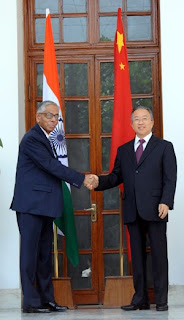
However, 2009 does not appear to be as good a year as it had been over the past few years in respect of the Indo-Chinese relationship. The recent developments that include more frequent Chinese intrusions into Indian territory, the 'Google map' controversy, formal Chinese objection to Indian Prime Minister's visit to Arunachal Pradesh for election campaign, reports on discriminatory Visas being issued by China to Kashmiri Indians and construction of a dam on the Chinese side of Brahmaputra, do not point to improving relationship between the neighbours. Notwithstanding the media hype, the Government of India has consistently been adopting a reconciliatory position towards China, while equally and unequivocally sticking to known positions. According to India's Secretary to External Affairs Ministry, Nirupama Rao, Indo-Chinese border dispute is one of the most complex international disputes that should be handled with care and determination on both sides to gain common ground.

Let us watch how this diplomatic challenge is handled in the days to come, fingers crossed!

Photograph Courtesy:
Wikipedia (for Kashmir disputed region map)
Xinhua (for Indo-Chinese Diplomats during 2009 August talks)

Friday, October 02, 2009

"We must be the change we wish to see" - M.K.Gandhi

Born in 1869, it is 140 years since the birth of the Father of Indian nation. Today is celebrated as the 140th birth anniversary of Mohandas Karamchand Gandhi.

Gandhi, revered as the 'Mahathma' (meaning, 'the great soul'), lived a life that conveyed his own message to the whole world. The message of the 'Mahathma' is becoming more and more relevant in today's world that unfortunately, seems to be heading towards the path of intolerance among communities, groups and nations.


Despite man intellectually equipping himself better than several centuries ago, his outlook, instead of becoming broader and more inclusive, has been shrinking and becoming more self-centred. Instead of using his skills and abilities to promote the welfare of mankind, he has been misusing them leading to his own destruction.


The ideas and teachings of Gandhi are clear messages to those in positions of power to follow, if not emulate. Gandhi believed that "we must be the change we wish to see". Do our politicians seem to at least understand the underlying message?

Friday, July 10, 2009

Vipassana - a Gateway to Peace of Mind and Salvation

Simply inexplicable was the kind my experience after having spent a clear ten day-session of Vipassana, between June 4 and 13, 2009 at Dhamma Setu - the Meditation Centre at Tirumudivakkam, located a couple of kilometers off Tiruneermalai in the outskirts of Chennai city.

Having registered for the session after going through the Code of discipline that include the following five precepts to be undertaken during the session, I reached the Centre around 3 pm on the 3rd of June where I had to spend till the morning of 14th June 2009, 'as if all alone'.

The five precepts were:
  1. to abstain from killing any being;
  2. to abstain from stealing;
  3. to abstain from all sexual activity;
  4. to abstain from telling lies;
  5. to abstain from all intoxicants.
Apart from the above, the participants were expected to maintain noble silence throughout the session barring the last day. By noble silence is meant silence of body, speech, and mind. Any form of communication with fellow participant, whether by gestures, sign language, written notes or any other means is prohibited.

Students were however allowed to speak with the teacher whenever necessary and they could also approach the management with any problems related to food, accommodation, health or similar issues. But even these contacts were be judiciously exercised. Students were expected to cultivate the feeling that they were working in isolation.

Other conditions included decent and simple clothing, prohibition of physical contacts with others (whether men or women), suspension of any physical exercise, Yoga or similar activity except walking within the campus, prohibition on the use of religious objects, rosaries, etc., and ban on entertainment (including music, listening to radio), use of mobile phones, cameras or tape recorders, reading and writing during the duration of the session.

Vegetarian food is served to the participants at periodic intervals, but the timing and type of food is carefully chosen in order to ensure that the objective of meditation is not hindered.

Though difficult to believe, the fact remains that the whole course is offered free of cost to the participants, on the principles of charity. Voluntary contributions in the form of donations are however accepted from the beneficiaries.

The technique
The technique is said to have been existent in ancient India that eventually became almost extinct several centuries ago. However, it was rediscovered by Gautama, the Buddha who lived about twenty five centuries ago. The technique requires no external objects, but is solely dependant on one's determined efforts to observe and understand the self. Buddha termed realisation of the self as the path of Dhamma which is a way of life that can be practised by any human being irrespective of sectarianism of divisions among the people in the name of religion, caste, creed, community, language, region or similar barriers.

In course of time, the practitioner realises the power of concentration of one's mind and utilises this tool to gradually gain access to the universal truth which is also called enlightenment. By reaching a stage whereby one learns to maintain mental tranquility and equilibrium at all times - whether in times of ecstasy or turbulence - one is liberated from the influences and impact of the external wordly changes. This is the stage that brings permanent peace of mind. This is when one gets freedom from hatred, anger, jealousy and such other negative emotions. This is when one understands true love without expecting anything in return alone brings permanent happiness.

More Information
I am delighted to share with the readers the source of more information about this technique and encourage one and all to undergo this inexplicable experience at least once in their life time.

Tuesday, September 30, 2008

True colours of the nuclear deal - Dr. P.K.Iyengar, Former Chairman, Atomic Energy Commission, India

The US House of Representatives has passed a bill (H. R. 7081) that approves the 123 Agreement, but which is contradictory to the assurance given by the Prime Minister to the nation. An identical version is before the US Senate for voting. Even as late as 26 September 2008, the Prime Minster was seeking an agreement that would ‘satisfy India’. This has not come to pass, and it will be interesting to see how the Indian government and the Indian media will ‘spin’ this into a victory for India. The Indian side is supposed to have been unhappy with the language. The fact is that one is not worried about the language, but the content and compulsions of the Bill.

Why is the House bill not satisfactory? Even the title of the Bill, ‘United States-India Nuclear Cooperation Approval and Nonproliferation Enhancement Act’, makes it clear that they seek to press their non-proliferation agenda. The Bill makes a number of things explicitly clear, and reveals the true colours of the nuclear deal.

(1) The 123 Agreement is subject to the provisions of the Hyde Act and the Atomic Energy Act, and does not supersede them.
This is said, in so many words, twice in the Bill. Section 101 (page 3, lines 16-21) says that: “The Agreement shall be subject to the provisions of the Atomic Energy Act of 1954, the Henry J. Hyde United States-India Peaceful Atomic Energy Cooperation Act of 2006, and any other applicable United States law.” Section 102 (page 6, lines 8-12) reiterates that: “Nothing in the Agreement shall be construed to supersede the legal requirements of the Henry J. Hyde United States-India Peaceful Atomic Energy Cooperation Act of 2006 or the Atomic Energy Act of 1954.” Therefore there is now no question of differences in the ‘interpretation’ of the 123 Agreement. Irrespective of what we think we are bound by, the Americans have made it abundantly clear that they are bound by the Hyde Act and the Atomic Energy Act, and the 123 Agreement does not supersede either of them. If we conduct a test it is now abundantly clear that, as per the provisions of the Hyde Act and the Atomic Energy Act, it is the end of the nuclear deal.

(2) In the event of a disruption of fuel supply from the US, the Americans will not help arrange for fuel from another country.
Article 5(b-iv) of the 123 Agreement says that in the event of fuel disruption the US will help India get fuel from ‘friendly supplier countries’. But it seems that the Congress is having none of this. Section 102 (page 5, lines 4-12) of the Bill explicitly states that in the event of fuel disruption, not only will the US not help arrange for fuel from other countries, but it will also “seek to prevent the transfer to India of nuclear equipment, materials, or technology from other participating governments in the Nuclear Suppliers Group (NSG) or from any other source.” Since this sentence is not in the 123 Agreement, the Indian government will probably claim that we are not bound by it. However, the simple reality is that if there is a disruption of fuel from America, for whatever reason, the Americans will work hard to ensure that we do not get it from any other source.

(3) There will be no transfer of enrichment technology, and even permission for reprocessing imported fuel may be denied.
This is the most disturbing clause in the Bill. Sec. 204 of the Bill (page 14, lines 11-19) says explicitly that before the 123 Agreement enters into force (according to Article 16), the President has to certify that the US will work with NSG countries to “agree to further restrict the transfers of equipment and technology related to the enrichment of uranium and reprocessing of spent fuel”. So, one of the major advantages we were expecting from the NSG waiver and the 123 Agreement will not be forthcoming. But this Bill goes even further. Section 201 makes it very clear that any future proposal for reprocessing needs explicit approval from the US Congress, and the Congress retains the right to refuse (page 13, lines 1-4). This is a new twist, and extremely dangerous, because it leaves us completely at the mercy of the Congress. The same section also says that the US will pursue efforts with other countries to ensure that reprocessing of fuel from those countries will also be governed by ‘similar arrangements and procedures’. This seems to suggest that the US would even like the existing arrangements with Russia for the Kudankulam reactors to be modified along the proposed lines. The same would also apply to any other supplier. It is surprising that in spite of our being a ‘strategic partner’, the US wants to restrain our fuel-cycle developments. This shows, again, that India is not being treated as an equal, in spite of the fact that for decades India has developed reprocessing and enrichment technology on its own, and produced plutonium for fast-breeder reactors as well as enriched uranium for the submarine reactor.

These explicit statements in the House Bill only reaffirm what many of us have been saying for a long time. The 123 Agreement does not supersede, and is constrained by, the Hyde Act and the Atomic Energy Act. The House Bill has added new constraints. The entire Indo-US nuclear deal, which must now be taken to comprise of the Congress Bill, the 123 Agreement and the Hyde Act, is in contradiction to the July 2005 Joint Statement, because it doesn’t give India the status of an advanced nuclear state enjoying the same obligations and benefits as others. The nuclear deal does not allow cooperation in enrichment or reprocessing technology. The nuclear deal does not guarantee fuel supplies or a fuel reserve. In the event of a breach of the 123 Agreement, the US will not work with its allies to find alternate solutions – on the contrary it will pressure them to act against Indian interests. ‘Full cooperation’ in civil nuclear power is meaningless without assurances of fuel supply and technological cooperation in the fuel cycle.

The House Bill also makes it clear that the US continues to impose on us the existing non-proliferation regime, and is not ready to recognize India as a nation with advanced nuclear technology. President Bush may have made many promises, but he will not be around to fulfill them. The reality is that the nuclear deal will not bring us as equals to the nuclear table. It will only serve to tighten the non-proliferation regime around us, make us dependent on the nuclear cartel for fuel, and completely cripple our strategic programme.

If the government’s intention is to import nuclear reactors and fuel, a simple bilateral agreement, which guarantees application of safeguards to the reactors, the fuel, and the end products of reprocessing the fuel, would have been sufficient and meaningful. There is already a precedent for this. In the nuclear deal with Russia, the irradiated fuel from the Kudankulam reactors can be reprocessed in India, provided this is done under IAEA safeguards. The plutonium that is produced in these reactors, when separated, will also attract IAEA safeguards. This is perfectly understandable, and India has accepted this. Why this should not be applicable in a more friendly agreement with the US, is incomprehensible.

In 1974, when India was less developed and had a bleaker future, Indira Gandhi  was able to stand firm in supporting a strategic programme, in spite of ominous warnings of the retribution that would follow. It is ironic that in 2008, when India is in a much stronger position, economically and geopolitically, her own party is ready to betray her legacy and put on nuclear shackles, for a few dollars more.

Tuesday, September 09, 2008

Why does the Government shy away from the people of India?

Amidst rhetoric praising the recent NSG clearance of the Indo-US Nuclear deal as a landmark victory (whose victory is it, anyway?) , those at the helm of the Government of India show no signs of respect to the voice of the people of this great country as evident from their deliberate decision to shrug off their responsibility to convene the monsoon session of the Parliament! This is against the established tradition since indepdence.

Jettisoning the Parliament session has serious implications. Apart from violating the basic principle of governance, the absence of the Parliament session negates the legislature's right and the executive's obligation. The country's sovereignty rests with the people and the executive is accountable to the legislature which in turn, is accountable to the people. The act of jettisoning the monsoon session of the Parliament is a serious compromise with the concept of sovereignty itself as enshrined in the Constitution, particularly at a time when major decisions are being thrust on the country by external elements with the tacit support of those in power.

The Government of India found itself isolated when certain classified documents related to Indo-US Nuclear deal were published by the United States, because, what was publicised was diametrically against what the representatives of the people were made to believe! Parliament being the available forum for questioning this infidelity, the people of the country are denied this legitimate avenue.

The unprecedented levels of inflation, agrarian crises, the unabated fundamentalist aggression against the lives and property of the innocent people of Orissa, the inexplicable lapses that led to the breach in the embankments of River Kosi that changed its course causing unbearable loss of lives and property due to floods in Bihar and elsewhere, are all issues of national importance to be discussed threadbare in the Parliament. By depriving the people of India of their legitimate right to voice their concern in the Parliament on these important issues, the Government has been indulging in an open challenge to democratic values and norms.

Is the voice of the people of this country subdued by voices from external sources to which the Government appears to be very attentive these days? The people of India have the right to know this.

Saturday, June 21, 2008

Is the Left Right on Indo-US Nuclear Deal?

For some time now, arguments and counter-arguments in favour of and against the Indo-US Nuclear deal have been appearing in the media though it never has leapt to such prominence as it has now! The reason - both the camps in India - those who argue in favour of the deal and those against it - have almost reached a point of no-return. And now, the question is whether the LEFT is RIGHT ? Let's now attempt to analyse.

Petroleum (Oil), Natural Gas, Electricity, Coal, Renewable and Alternative fuels (including Hydro-power, Solar, Wind, Geothermal, Biomass and Ethanol) are the sources of Energy apart from the Nuclear source. Statistics show that 81.7% of India's Electricity production is Fossil-fuel based and 14.5% from Hydro. India consumes 339 million short tons of Coal per year - third in the world, next only to China and the U.S.A. (Courtesy: www.nationmaster.com). Consuming just 17.8 tera-watt hours of Nuclear Energy per year, India's Nuclear Energy share is a mere 0.7%.

In India, energy is predominantly consumed by the Transportation Sector and according to International Energy Outlook released last year by Energy Information Administration of the U.S. Government, India's transportation energy use is projected to grow at 3.3% per year as against the world average of 1.7% per year. The document anticipates that India will continue to expand its public transportation networks over the projection period, allowing robust increases in both road and rail transport and resulting in a more than doubling of transportation energy use between 2004 and 2030. India launched her National Highways Development Project (NHDP) in 1998 to modernize her major highways. The first phase of the project—the “Golden Quadrilateral,” a 3,625-mile multi-lane highway system that connects Delhi, Mumbai, Chennai, and Calcutta—was completed at the end of 2006. The second phase—the North-South and East-West national highways that will connect the outermost points of the country—will comprise more than 4,200 miles of highway.

Then comes the Industrial Sector, Commercial Sector and the Residential
Sector. In India, following the Transportation Sector, energy is consumed by Petro-Chemicals and Fertilisers. Only a negligent amount of Oil is used in Power Plants in India. Even according to the U.S. Government document, "Although electricity is expected to become an increasingly important component of industrial sector delivered energy demand in the non-OECD economies, oil, coal, and natural gas were the most heavily used fuels in 2004, and they are projected to remain so in 2030. Liquids use in the non-OECD industrial sector increases at a slower rate than natural gas or coal use. The continued importance of coal in the non-OECD industrial sector is largely attributable to China, which accounts for 70 percent of industrial coal use in the non-OECD economies in 2030."

It is anybody's knowledge that Nuclear source of energy cannot be consumed directly by the Transport Sector - India's predominant consuming sector! After all, Oil cannot be substituted in this sector by any other form of energy. However, it is also common knowledge that Iran-Pakistan-India Natural Gas project, if materialises, will definitely reduce, if not eliminate, the pressure on the economy due to spiralling Oil prices. Our analysis revolves around the stand of the UPA Government at the Centre vis-a-vis the Left parties that support the Government on these two major policy decisions - one, emphasis on the Nuclear deal that is projected to be save the country from all our energy-related problems; and two, lacklustre attitude in finalising the Iran Gas Project as if it were not to benefit the country's quest for energy.

It is hard to ignore the following fact sheet put forth by the Left Parties under these circumstances.

· India's growing shortage of electricity has little to do with a lack of nuclear energy but a lot to do with starving the power sector of public investments over the last two decades. In the last three Five-year plans, capacity additions has been of around 20,000 MW per Plan, less than what we had added in the 7th Plan.

· Even if the Deal is signed today, it will take about 8 years before any electricity is produced from imported reactors under the Deal

· The cost of installing nuclear power plants using imported reactors is three times that of coal-fired plants of the same size

· The cost of electricity from such plants will be more than Rs. 5.00, twice that from coal-fired plants

· The quickest and cheapest way to remove the current electricity shortages is to build coal-fired plants which take half the time required by nuclear plants

· Nuclear plants require imported uranium, which is controlled by a small international cartel. The price of uranium has gone up by five times in the last few years because of this cartel.

· Nuclear energy has an important place in India's energy option and this route needs to be kept open for the future. However, this should be based on our indigenous technology and our indigenous resources to ensure energy security.

· Even with the most optimistic nuclear scenario that the Government has projected, Nuclear energy will at best meet only 8% of our electricity demand and about 4% of our total primary energy demand. While the nuclear option should be kept open for the future, it has little importance for meeting our immediate energy needs.

The question before the people of India should, therefore, be not about the loss of face for the architects of the Nuclear deal - the Indian Prime Minister Manmohan Singh and the U.S. President George Bush, but about preserving the independence and sovereignty of the great country whose Foreign Policy has stood the test of time for its inherent non-aligned nature.


Sunday, March 04, 2007

Planning travel within India

A well-planned vacation to India can get rid of several hassles. Whenever I go to India on vacation, I use to make sure the following:

Travel to a new location with family and spend a few days there. Most of the time, the new place that I travel to happens to be a hill resort, coastal town, jungle/sanctuary or heritage site.
Plan the travel dates well in advance and reserve air tickets or railway tickets, as the case may be, almost always online.

Chart out my itinerary and send it to my family in India so that they will make advanced bookings of accommodation in the places covered by itinerary.

Gather all possible information about the new places that I intend to travel from the internet and take with me the necessary kit such as blankets, etc. during the travel

It is heartening to note that Indian Railways have commissioned a portal for advance reservations. For the sake of fellow Indians, I am furnishing the link hereunder. All that you need to do is REGISTER with a local Indian address and reserve your tickets online using Credit Cards. Tickets will be delivered at your local Indian address within 2 days by courier.

http://www.irctc.co.in/

Friday, March 02, 2007

Promote peace and harmony everywhere!

Human life is distinct from other forms of life primarily in our capacity to logically analyse situations and apply prudent decisions suitable to dynamic situations. The intelligence vested in human beings is unparalleled. Still, we see around us reprehensible actions initiated by misguided people who fail to uphold legitimate values of civilised society.

We see people fighting against each other, emotionally surcharged and spit the venom of hatred and violence - all in the name of illusory man-made divisions. We see violence and hatred gradually and systematically spread in the society like a cancer. Patriotism, Religion, Ethnicity, Language and all sorts of social divisions among the human race are being taken advantage by vested interests to propagate their self-defeating goals that help them reach nowhere.
Civilised society has its firm roots in the principles of co-existence with peace and harmony. Faith or religions are intended to uplift the human intellectual levels and regulate their life style. These are not meant to be misused for any purpose, whatsoever. No person who faithfully upholds the values taught by his or her own religion can afford to hate. On the other hand, love for humanity and all other forms of life is what one's religion will inculcate in one's intellectual realm. At least to my knowledge, there is not a single religion that direct people to fight with each other. Religious tolerance is the hall mark of a matured civilisation.

Under growing deterioration of moral values alround, it is the duty of each and everyone of us to bring up our siblings as genuine followers of the concepts of love, tolerance and mutual co-existence. Let us all strive to achieve this goal for sustaining and upholding the intellectual enrichment of human lives.